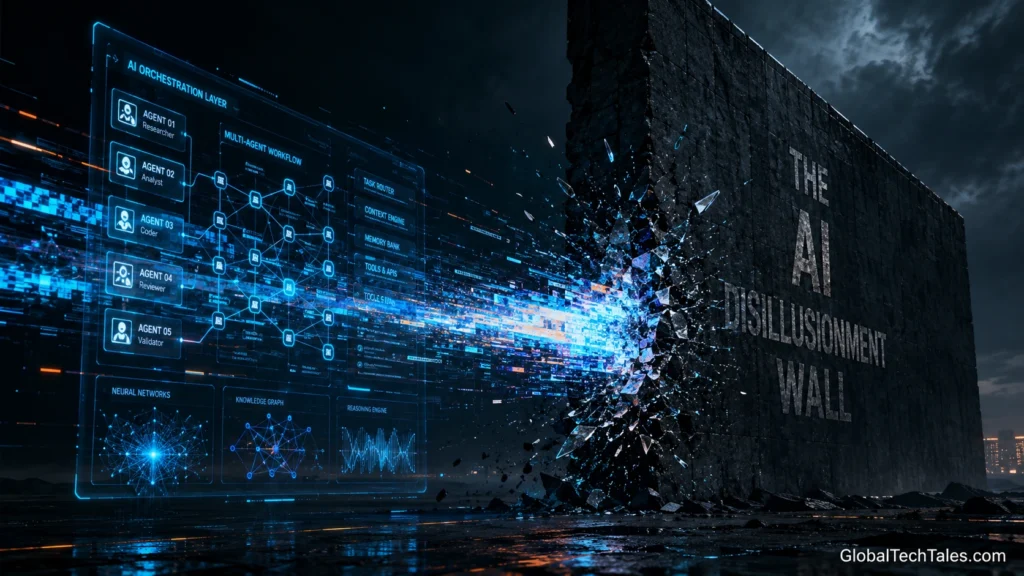
Whether you are using a $20/month commercial chat subscription or deploying a multi-million-dollar custom enterprise agent, artificial intelligence faces an unavoidable architectural boundary: the AI Disillusionment Wall. From individual creators trying to render styled grid posters to Fortune 500 engineering teams attempting to generate full 8K feature films from a single prompt, systems across the entire cost spectrum hit identical mathematical, physical, and legal limits. The assumption that throwing more capital or compute at a single prompt will magically yield end-to-end media production is collapsing against real-world execution testing.
The core issue spans every price tier. A $20/month chat window fails because it lacks native rendering pipelines and output token bandwidth. Meanwhile, a $10,000,000 custom multi-agent enterprise framework fails when forced to run a single-pass “one-prompt” film production because latent diffusion models cannot hold 3D physical consistency, temporal narrative logic, or 8K resolution over extended timeframes without scene-by-scene orchestration. Overcoming the AI Disillusionment Wall requires accepting that no single AI tool—regardless of its price tag—can replace structured, multi-stage software engineering.

Universal Boundaries: Why the AI Disillusionment Wall Hits Every System Scale
A widespread myth in the tech landscape is that project failures are merely a artifact of cheap, consumer-grade software. Users assume that while a basic web interface stalls on a prompt, a multi-million-dollar AI agent framework can effortlessly ingest a master instruction and output a completed movie, a 50,000-word book, or a complex geopolitical visual database. In practice, enterprise benchmarks reveal that the AI Disillusionment Wall impacts high-budget corporate infrastructure just as severely as entry-level tools.
Industry evaluations published in the Stanford Human-Centered AI Index demonstrate that while scale improves pattern recognition, it does not eliminate fundamental systemic bottlenecks. Advanced multi-modal models still suffer from memory degradation over long horizons, spatial misalignments during coordinate layout generation, and strict red-teaming safety locks mandated by regional law.
When an enterprise team spends millions building autonomous agents, they are essentially linking multiple neural networks together via APIs. However, if the underlying generative models themselves cannot calculate exact pixel coordinates for text placement or hold facial geometry across thousands of video frames, the entire multi-million-dollar stack stumbles. The AI Disillusionment Wall is not a pricing tier issue; it is a fundamental property of transformer architectures and diffusion physics.
Industry Reality: No AI platform on Earth—regardless of funding—can generate a finished, photorealistic 8K feature film from a single prompt without scene-by-scene breakdown, character reference locking, and post-production upscaling.
Anatomy of Failure: Dissecting Real-World Execution Bottlenecks
To understand why systems at all price levels stall during complex tasks, we must examine the specific technical walls that hit both consumer subscriptions and custom enterprise workflows.
1. Visual Registries, Biometrics, and Spatial Typography
Consider a task asking an AI to identify specific historical figures, retrieve exact mugshot-style photographs, format them into a poster-sized grid, and print precise text titles directly beneath each image. This request collides directly with the AI Disillusionment Wall in visual precision across all platforms:
- The $20 Chat Subscription Failure: The model generates garbled text, hallucinates facial features, mixes up captions, or refuses the query outright due to global safety filters prohibiting person-identifiable tagging.
- The $10,000,000 Enterprise Agent Failure: Even if custom scrapers retrieve authentic public images, generative diffusion engines operate probabilistically rather than deterministically. They cannot guarantee that text labels will align perfectly beneath image grids without using programmatic canvas code (such as Python Pillow or SVG generation) to draw the final layout.
Infographic: The Dual-Tier Execution Spectrum
$20/Month Consumer Tier
• Monolithic Chat Window
• ~4,000 Word Output Cap
• Rigid Broad Safety Filters
• No Native Video Pipeline
• Single-Prompt UI Bottleneck
$1M+ Enterprise Agent Tier
• Multi-Agent API Mesh
• High-Throughput Batching
• Custom Legal Wrappers
• Dedicated GPU Rendering
• Physics & Temporal Limits
2. Native Video Generation and the “8K Single-Prompt Film” Myth
Creators frequently ask why an AI cannot generate a simple 10-second thriller teaser, or why a multi-million-dollar AI agent cannot produce an entire feature film from a single prompt. This is where the AI Disillusionment Wall stops video production across all price brackets:
Generative video platforms like Google Nano Banana and Kling AI video systems showcase breathtaking motion synthesis, but they render video in 5-to-10-second probabilistic slices. Attempting to skip scene-by-scene integration causes instant failure for two technical reasons:
- Temporal Drift and Physics Glitches: Without explicit scene-by-scene prompt framing, seed locking, and 3D mesh tracking, an AI model cannot maintain character faces, clothing textures, or lighting conditions across long takes. Characters morph, environments warp, and narrative continuity breaks down.
- Resolution Latency Limits: No video foundation model natively calculates raw 8K video in real-time. High-resolution output requires generating raw 1080p clips first and passing them through dedicated spatial upscalers in post-production.
“The belief that enterprise AI can bypass the laws of signal processing and temporal memory is the primary driver of project failure. Prompting is not software engineering, no matter how much capital you burn.”
— Enterprise Technology Analysis, Gartner Emerging Tech Strategy
Technical Root Causes: Comparing Consumer vs. Enterprise Barriers
To evaluate how the AI Disillusionment Wall manifests across different infrastructure scales, examine the underlying technical constraints governing current AI models:
| Technical Constraint | $20/Month Chat Subscription | $1,000,000+ Custom AI Pipeline |
|---|---|---|
| Primary Execution Failure | Output token caps & UI limits | Temporal drift & 3D consistency loss |
| Max Output Per Pass | ~2,000 to 8,000 Words | Programmatic batching (requires assembly) |
| Visual Layout Precision | Probabilistic / Text corruption | Requires deterministic code overlays |
| Video Rendering Capability | None or basic short clips | Multi-engine API calls (scene-by-scene) |
| Legal Safety Guardrails | Rigid global keyword blocks | Custom API enterprise red-teaming |
The Input-Output Asymmetry & Context Decay
In long-form text synthesis—such as drafting a 50,000-word book manuscript—both consumer subscriptions and custom enterprise stacks hit context bottlenecks. While modern models boast massive input context windows, their single-turn output generation remains strictly throttled by API token limits.
As generation length increases, transformer models suffer from context rot. The system loses track of earlier plot beats, introduces repetitive syntax, and breaks logical continuity. Custom agentic systems handle this by chunking text into smaller 1,500-word segments, proving that one-prompt generation hits the AI Disillusionment Wall regardless of budget.

Legal and Regulatory Compliance: The Unyielding Safety Boundary
Beyond hardware and mathematical constraints, international cyber laws and safety frameworks enforce boundaries that affect all AI systems equally. Enterprise agents operating with millions in funding must obey the same legal mandates as consumer apps.
As documented in our 2026 guide on AI privacy and compliance laws, regulatory bodies enforce strict penalties for generating unauthorized biometric imagery, deepfakes of public figures, or copyrighted content. When an enterprise agent scans public databases for targeted human photos or commercial assets on platforms like Amazon, automated legal compliance wrappers trigger immediate execution halts.
This strict boundary is especially visible in security-critical environments. As explored in recent findings on biometric reasoning frameworks in modern infrastructure, security protocols demand 100% deterministic verification. Generative models cannot be trusted to probabilistically recreate sensitive identity data, reinforcing the AI Disillusionment Wall around safety-critical operations.
The Agentic Solution: How to Engineer Around System Limits
If single prompts fail at every price point, how do top-tier engineering teams build functional AI systems? The answer lies in replacing the “one-prompt” fantasy with a modular **Agentic Workflow Architecture**.

Instead of expecting a single model to act as researcher, artist, writer, and editor simultaneously, an agentic system breaks the project into distinct programmatic steps:
- Deconstruct the Pipeline: Separate research, drafting, image generation, and video compilation into isolated micro-tasks.
- Use Deterministic Code for Layouts: Generate raw background imagery using diffusion models, but use code libraries (such as Python PIL or Canvas APIs) to place text, titles, and borders with exact pixel precision.
- Orchestrate Video Scene-by-Scene: Generate short 5-second video clips independently, locking character seeds across frames, and stitch them together inside a non-linear video editing (NLE) timeline.
- Process Long Text Iteratively: Draft long scripts or books in sequential 1,500-word chunks to prevent memory context rot.
For organizations seeking complete operational autonomy without third-party API restrictions, setting up a local AI agent server provides dedicated hardware control, allowing teams to run fine-tuned models tailored to specific technical tasks.
Frequently Asked Questions (FAQ)
What is the AI Disillusionment Wall?
The AI Disillusionment Wall describes the technical boundary where generative AI models—ranging from $20/month subscriptions to multi-million-dollar custom enterprise setups—fail to execute complex, end-to-end tasks from a single prompt due to token caps, spatial layout limits, and temporal video drift.
Can a multi-million-dollar AI agent make a full movie from one prompt?
No. No AI platform exists that can generate a complete feature-length film in 8K from a single prompt. High-end video production requires breaking scripts into individual scenes, locking character references, and assembling clips on a timeline.
Why do AI models fail at putting exact text under specific images?
Image diffusion models generate visuals probabilistically rather than deterministically. They lack precise coordinate mapping tools. Aligning text underneath specific generated grid cells requires combining AI imagery with traditional graphic layout code.
How do developers bypass the AI Disillusionment Wall?
Developers bypass the AI Disillusionment Wall by abandoning single-prompt expectations and building modular agentic workflows that break projects into structured, multi-step API tasks combined with traditional software code.
Conquering the AI Disillusionment Wall demands moving past the illusion that a single prompt can direct an entire enterprise project. By understanding the real boundaries of generative technology and building structured, step-by-step agentic pipelines, creators and engineers can achieve production-grade results at any budget level.