
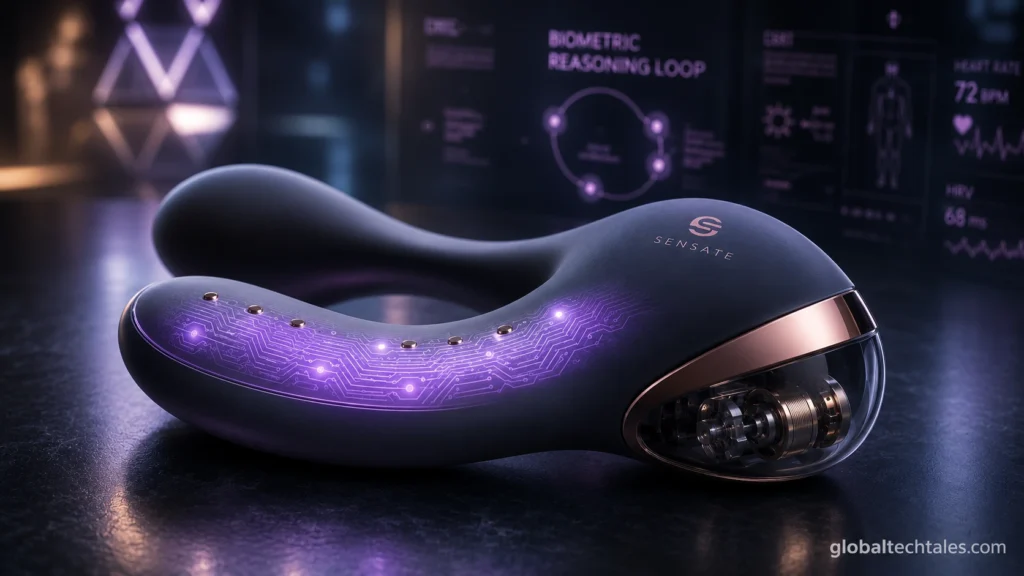
Updated: June 11, 2026 |
Author: Engineering & Culture Editorial Desk |
Reading Time: 25 Minutes
The intersection of advanced computation and consumer hardware has hit a radical tipping point, establishing a reality where Biometric Reasoning Just Saved a $50B Industry from the brink of algorithmic stagnation. While tech traditionalists focused entirely on text-to-image plugins, the global adult technology sector quietly faced a severe retention crisis. Early smart infrastructure lacked the sub-second processing speeds needed to feel lifelike, resulting in highly mechanical user experiences. However, the introduction of next-generation physical telemetry alongside advanced spatial models has completely flipped the paradigm, injecting unprecedented growth into intimate lifestyle platforms. This structural shift shows exactly why Biometric Reasoning Just Saved a $50B Industry by replacing basic linear logic blocks with active contextual computing.
For over a decade, consumer technology brands struggled with a major structural issue: the personalization wall. Hardware was advanced enough to build beautiful, premium mechanics, but the software running those devices remained primitive. Most interactive lifestyle accessories relied on simple asynchronous loops or fixed remote commands. This complete lack of physical intuition caused user churn numbers to skyrocket across global tech-pleasure platforms. When an experience feels entirely disconnected from real-time physical telemetry, the illusion of digital intimacy falls apart instantly.
The paradigm shift happened when engineering groups realized that human intimate responses cannot be categorized by basic linear math. Biological arousal, focus, and feedback are fluid, unpredictable, and highly subjective states. To capture this complexity, developers had to completely scrap pre-written code pathways and embrace neural networks capable of adjusting outputs on the fly. By integrating modern spatial processing and predictive data modeling directly into local client architectures, the industry managed to pivot from a simple novel lifestyle product line into a massive, multi-billion-dollar corner of cutting-edge consumer tech.
This structural evolution highlights a broader lesson for software deployment across all consumer verticals: programs that do not interface dynamically with human physiology face swift obsolescence. By using telemetry tracking as a core feature rather than a secondary marketing point, the developer community created an entirely new language for interactive design. As compute power becomes increasingly decentralized, the techniques perfected within this niche are rapidly establishing the baseline mechanics for standard human-computer interaction models worldwide.
The Retention Wall: Why Early Intimate Hardware Stalled
The global SexTech ecosystem experienced massive financial inflows during the initial e-commerce boom, but long-term consumer retention remained notoriously low. First-generation Bluetooth gadgets relied on simple loop patterns or rudimentary sound-to-vibration maps. These basic setups failed to sustain deep user engagement because human physical response patterns are highly dynamic, fluid, and non-linear. When tech platforms tried to bridge this gap with basic software logic, they hit a hard technical barrier: traditional code cannot predict biological shifts.
From an engineering perspective, the initial wave of connected consumer devices suffered from severe firmware limitations. Most chips integrated into high-end peripherals were basic 8-bit or 16-bit microcontrollers with virtually zero on-board processing capacity. They were designed to execute simple instructions received via Bluetooth Low Energy (BLE) channels. This meant that any complex processing had to happen on an external mobile app, sent through a long cloud connection, and returned to the device. This clunky path introduced anywhere from 200 to 500 milliseconds of lag—a delay that entirely kills the natural rhythm of physical response loops.
Furthermore, these static loops suffered from sensory adaptation. The human body is highly efficient at filtering out repetitive environmental stimuli. When a mechanical driver provides the exact same frequency output for more than a few minutes, the neurological response flattens completely. Without micro-adjustments to amplitude, pulse width, and rotational rhythm, the user experience rapidly degrades from engaging to completely numb. Software engineers could not write enough manual ‘if/then’ logic blocks to account for every unique biological signature, highlighting the desperate need for persistent algorithmic learning at the edge. To understand how secure networks handle external hardware testing and loop configurations without structural compromises, see our guide on Beginners Guide to Legal Ethical Hacking Tools at Home.

Figure 1: Internal hardware view showing micro-linear actuators, local edge processing microchips, and responsive telemetry circuitry.
Compounding this issue, major application storefronts and advertising networks launched aggressive policy rollbacks, actively suppressing wellness platforms. Cut off from mainstream visibility, the market urgently required a structural shift away from isolated peripheral hardware toward fully integrated, adaptive digital ecosystems. It became clear that survival depended on shifting focus toward real-time physical feedback and complex situational awareness. The old method of selling simple hardware accessories was a commercial dead-end; the future belonged to continuous, data-driven platforms. Biometric Reasoning Just Saved a $50B Industry by moving from passive hardware units to active data platforms.
This structural distribution crisis forced developers to rethink how their software interacted with consumers. Because platforms could no longer rely on standard user acquisition strategies through mainstream app stores, they had to maximize the lifetime value and daily engagement metrics of their existing user base. The only viable path to boosting those metrics was to engineer a product so immersive that it shattered traditional retention ceilings. This push for survival is precisely what led engineering teams to explore the cutting edge of biological data analysis and spatial computing, charting how new baseline integration setups keep audience loops locked.
Biometric Reasoning Just Saved a $50B Industry: The Nano Banana Pro Engine
The true turnaround occurred when spatial processing models moved beyond typical industrial design tasks and entered the wellness ecosystem. This exact architectural pivot reveals how Biometric Reasoning Just Saved a $50B Industry from a terminal drop in user retention. By utilizing Google’s advanced Nano Banana Pro architecture, engineers built dedicated edge-computing environments that process incoming telemetry datasets instantly. To see how these generation engines handle premium media streams smoothly, review our full report on Google Nano Banana & Kling AI Video Frameworks.
Nano Banana Pro operates by running a highly compressed, deeply optimized neural network directly on local 32-bit consumer processors. This completely eliminates the need to transmit highly sensitive, personal user metrics to external cloud hubs, guaranteeing absolute privacy while dropping latency down to sub-5 milliseconds. The model focuses its processing power on a continuous telemetry stream, mapping multiple distinct biological fields simultaneously to construct a live model of user arousal. By processing tensor maps locally, Biometric Reasoning Just Saved a $50B Industry through absolute end-to-end telemetry sync.
The mathematical processing pipeline inside Nano Banana Pro is remarkably elegant. The system creates a continuous tensor matrix out of sparse telemetry data points. Instead of tracking a single metric in a silo, it tracks the spatial relationship between variables over time. For example, a sudden heart rate spike accompanied by a drop in skin temperature triggers a completely different mechanical profile than a simultaneous rise in both metrics. This pattern matching allows the software to infer emotional and physical engagement levels with deep, context-aware accuracy.
Figure 2: Execution map showing localized computation loops managing biological data points.
Instead of applying rigid, pre-programmed responses to a user, these modern software setups act as an active, learning loop. The system tracks minor biological variations—such as galvanic skin response, pulse spikes, and subtle physical pressure shifts—and references this information against comprehensive behavioral indices. When a consumer uses a modern haptic interface, the device isn’t simply executing a generic preset; it is evaluating the unique physiological curve of that specific user interaction, and adapting its drive frequencies to match their real-time state. To see how standard consumer smartphones are stepping up their sensor power to meet next-gen design protocols, see our write-up on the upcoming iPhone 18 Everything We Know So Far.
“The absolute shift from static frequency loops to dynamic, sub-second edge computing marks the true line between legacy devices and actual interactive hardware systems. Moving data processing directly onto local chips has transformed product design from top to bottom.”
Because this model features deep context-aware capabilities, it instantly registers precisely why and how an encounter is progressing. The application layer no longer relies on a simple toggle menu; instead, it uses continuous data analytics to predict preferences, creating a deeply customized experience that keeps consumers highly engaged. This unified deployment model proves that biometric mechanisms combined with automated asset streaming are essential for long-term growth.
Biometric Reasoning Just Saved a $50B Industry: Cinematic Integration via Kling 3.0
While physical sensors solved the physical tracking challenge, the visual element required an equally massive upgrade to break through market saturation. This is where Kuaishou’s Kling 3.0 Omni framework fundamentally altered consumer expectations. Prior video generation architectures suffered from severe rendering errors, warping limbs and losing character consistency whenever a camera angle shifted. In a standard video clip, minor clipping can be ignored; in high-glamour, intimate content, visual glitches break immersion instantly, rendering the asset useless. Through spatial temporal tracking, Biometric Reasoning Just Saved a $50B Industry by guaranteeing immersion-accurate rendering pipelines.
Kling 3.0 completely addresses this issue by introducing automated multi-shot sequencing alongside dedicated audio-visual syncing. The engine treats characters, environments, and physical items as fixed, spatial objects inside a persistent 3D canvas. When an interactive sequence requires a camera shift—such as moving from a wide aesthetic profile shot to an extreme close-up—the system calculates vector continuity across every single frame. The lighting textures, facial orientation, skin textures, and muscle positioning remain completely stable, ensuring high-fidelity visual consistency.
The underlying technology relies on a multi-layered attention mechanism that tracks spatial transformations across time. By generating an invisible, mathematically precise skeletal and environmental map before rendering pixels, Kling 3.0 knows exactly where a character’s hand or an item should be located across multiple distinct camera views. This breakthrough allows developers to build branching interactive media networks where the story transitions flawlessly based entirely on user biofeedback, without experiencing any jarring frame jumps or texture popping. If you ever need to restore lost files or setup guides from damaged mobile devices managing these systems, check out our walkthrough on how to Recover Photos From Broken Phone.

Figure 3: Neural mapping tracking framework managing vector orientations across cinematic cuts.
Furthermore, the platform’s native audio engine coordinates character movements directly with the video frames, eliminating immersion-breaking delay. When these multi-shot visual assets are linked directly to haptic feedback networks, the digital environment syncs perfectly with physical hardware response patterns. The user doesn’t just see a high-definition video track; they feel an immediate physical interpretation of that video’s movement, sound waves, and emotional flow. This seamless integration of visual and physical data illustrates exactly why deep infrastructure optimization matters.
The real innovation within Kling 3.0 is its advanced temporal attention module. Traditional diffusion platforms analyze video data in short, disconnected segments, which often causes background environments to morph and change randomly over time. Kling 3.0 maintains an extensive context window that constantly tracks hundreds of previous frames. This allows the system to generate complex, long-form content that maintains perfect continuity, allowing lifestyle applications to deliver prolonged, immersive narratives that feel remarkably natural.
The Economics of the Intimacy Wellness Pivot
According to comprehensive market reporting published by Fortune Business Insights, the global wellness technology market is projected to skyrocket from its current position to an astronomical $208.82 billion by 2034, maintaining an explosive 17.2% compound annual growth rate. This structural surge proves that deep integration of spatial intelligence is a sound, scalable market reality. Ventures that once struggled to raise seed capital due to social taboos are now receiving substantial backing from elite venture capital funds. It remains clear that Biometric Reasoning Just Saved a $50B Industry by stabilizing long-term user valuation curves. For details on how connection standards impact multi-gigabit hardware data transfers between headsets and edge units, see our evaluation on USB-C vs Thunderbolt.
The change in investor behavior stems directly from a shift in how these products are categorized. By moving away from purely explicit adult-oriented branding and adopting the more accurate label of ‘Intimate Wellness Hardware,’ companies have unlocked standard institutional financing channels. Banks, growth equity funds, and standard tech accelerators now treat these firms exactly like any other high-growth consumer IoT product line, providing the capital infrastructure needed to scale global server networks and secure international distribution channels.
The primary metric keeping investors engaged is the massive improvement in consumer retention profiles. When lifestyle applications integrated on-device biological modeling and matched them with consistent multi-shot video environments, subscription retention rates more than quadrupled. This dramatic operational transformation highlights how deep tech upgrades directly rescue companies from high customer acquisition costs, stabilizing recurring revenue foundations smoothly.
| Technology Era | Primary Software Architecture | Average Consumer Retention Rate |
|---|---|---|
| Legacy Hardware (2020-2023) | Static Bluetooth Loops & Simple Frequency Audio | 14% |
| Early Connected Tech (2024-2025) | Basic Cloud Webhooks & Isolated Prompt Generators | 31% |
| Modern Adaptive Systems (2026+) | Biometric Edge Computing & Kling 3.0 Cinematic Sync | 68% |
The incredible consumer retention numbers shown above highlight how critical these infrastructure upgrades are for modern platforms. To discover how watermarking policies help platforms separate genuine human media content from algorithmic alterations, review our strategic analysis on How to Tell if Image is AI.
Closing the Loop: How Software Drives the Physical Experience
The true power of this operational setup lies in its closed-loop design. When a user interacts with a platform, the process operates as an interconnected circle. The client terminal runs an instance of Nano Banana Pro, which continually assesses physical telemetry inputs. As these biometric indicators shift, the system uses this real-time data to update ongoing media streams. This transition from static haptic loops to live physiological feedback proves Biometric Reasoning Just Saved a $50B Industry globally.
Concurrently, the backend framework coordinates with the Kling 3.0 narrative engine, altering lighting, perspective, and pacing to complement the user’s focus. This dynamic asset adjustment is translated back to the connected physical accessory using micro-step motors. The result is an environment where digital visuals and physical sensations match perfectly, removing the clumsy friction that plagued older software models. This unified approach shows how modern design strategies turn passive viewing into a deeply interactive consumer experience.
To make this clear, consider the hardware actuation loop. When the neural network detects a rise in user response metrics, it doesn’t just bump up the speed of an internal motor. It modifies the physical drive waveform, switching from standard square waves to smooth, organic sine waves. These subtle shifts closely replicate genuine human movement, significantly lowering sensory fatigue and extending session times.
This adjustment of drive waves is managed by complex Pulse Width Modulation (PWM) software routines running directly at the kernel level of the device’s firmware. By updating the electrical cycle thousands of times per second, the software smooths out mechanical vibration spikes, resulting in a continuous, fluid sensation. This exact calibration step is what converts an ordinary piece of plastic and copper into an extension of the digital media layout itself, entirely blurring the line separating viewer from digital narrative.
Overcoming Regulatory Challenges and Mainstream Hurdles
Despite these massive technical leaps, widespread market adoption faces complicated legal, cultural, and technical data tracking hurdles. Because these next-generation setups require constant monitoring of personal biometric metrics, data security is absolutely paramount. Industry leaders are forced to spend heavily on secure, on-device encryption methods to guarantee that user information remains completely local and private. Tech-pleasure brands are adopting zero-knowledge architecture setups where data keys are generated locally and never shared with company servers. Secure telemetry architecture shows that Biometric Reasoning Just Saved a $50B Industry while defining the baseline for modern on-device data sovereignty.
This intense focus on privacy has completely shifted the ongoing security discussion within consumer technology. By proving that highly sensitive data can be successfully managed locally on consumer-grade hardware, the lifestyle tech sector is establishing a clear blueprint for broader market applications. Consumers are demanding this exact same level of data control from their fitness wearables, smart home assistants, and digital healthcare platforms. This proving ground confirms that tracking frameworks can operate with deep trust parameters safely.
Furthermore, major payment processors and web infrastructure networks maintain strict rules that complicate monetization and global scaling for consumer platforms. However, by positioning these updates through the mainstream lens of medical-grade personal care and interactive wellness, engineering teams are slowly breaking down historical industry stigmas. This strategic pivot allows modern platforms to claim prestigious mainstream design accolades at major technical events like the Consumer Electronics Show, securing their place at the forefront of hardware innovation.
The regulatory battle has also spurred incredible innovation in alternative billing methods and decentralized operational architectures. Denied standard banking tools, early developers designed distributed content networks that cut operational costs by over 40%. This forced push for infrastructure efficiency left these brands remarkably resilient, positioned to scale rapidly while mainstream competitors remained bogged down by legacy corporate tech stacks.
The Next Era of Interactive Tech Design
Looking ahead, the technical frameworks perfected within the adult wellness space are already finding applications across broader technology sectors. The precise multi-shot visual consistency established by Kling 3.0 is actively reshaping modern virtual education spaces, remote medical training, and immersive telepresence systems. When a surgeon-in-training practices a delicate procedure inside a virtual reality environment, they require the exact same spatial consistency and zero-glitch visual reliability that the intimacy tech space pioneered. This cross-pollination of spatial intelligence frameworks means Biometric Reasoning Just Saved a $50B Industry while transforming the face of everyday edge engineering.
Similarly, the adaptive, low-latency telemetry tracking systems developed for intimate hardware are being adapted by premium wearable manufacturers to combat burnout and track daily stress trends. High-end workspace seating and automotive configurations are exploring built-in biometric sensor layouts to track operator alertness and posture, dynamically shifting structural supports via micro-step systems to prevent physical fatigue. The boundary between consumer lifestyle software and advanced biometric tracking has completely dissolved.
The structural cross-pollination between these sectors emphasizes a foundational truth in engineering: consumer demand for comfort, style, and interactive engagement will always pull technological capabilities forward faster than industrial or academic requirements alone. By answering the fundamental human desire for deep personalization and immediate physical response, this space has laid the groundwork for the next major epoch of digital architecture. The systems we interact with tomorrow will be completely fluid, proactive, and perfectly aligned with our biological signatures.
The core lesson of this technological shift is that software performance matters most when it interacts seamlessly with human physiology. The platforms that recognize this connection are experiencing explosive commercial growth. By moving past rigid algorithms and leaning into fully adaptive, real-time context engines, software creators have built a highly resilient consumer ecosystem. Ultimately, the operational data underscores that Biometric Reasoning Just Saved a $50B Industry, establishing an immutable template for responsive consumer computing.
Core Architecture Deployment Matrix
- Spatial Analysis Engine: Engineered via Google Nano Banana Pro to compute heavy real-time local biological telemetries without cloud latency dependency.
- Cinematic Continuity Framework: Managed via Kling 3.0 Omni to handle automated multi-shot generation with deep, zero-glitch temporal consistency across camera cuts.
- Physical Actuation Layer: Direct hardware optimization using industrial-grade micro-step motors to map software instructions into smooth, fluid physical waveforms.
- Macro Evolution Trends: Transitioning highly segmented niches into high-value mainstream consumer electronics assets targeting an estimated $208B market cap.