
✍️ Author: Anshuman Singh
⏱️ Reading Time: 18 Minutes
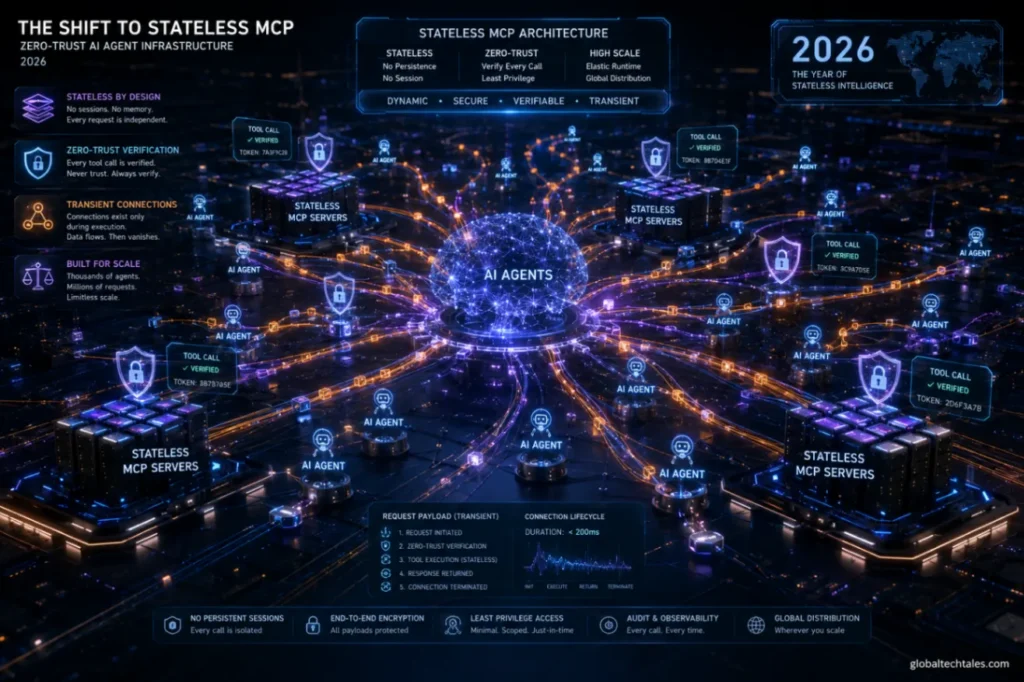
The deployment of multi-agent enterprise clusters has exposed a massive structural limitation in early AI infrastructure designs: the rigid dependency on persistent, stateful socket connections between orchestration layers and data systems. When an LLM application coordinates dozens of micro-tools simultaneously, maintaining long-lived TCP handshakes across disparate cloud instances leads to memory leaks, deployment bottlenecks, and single-point-of-failure risks. To build production-grade agent grids that scale horizontally across containerized nodes without dropping user contexts, enterprise software architects are transitioning toward a modular Stateless MCP paradigm. This structural shift strips away hidden session metadata from the transport layer, enforcing an explicit, decoupled communication highway where every individual payload carries its own verification, context reference, and processing parameters.
🛠️ Architectural Blueprint Summary
Methodology Focus: Decoupled JSON-RPC 2.0 Payload Execution + Cryptographic Ephemeral State Passing. By eliminating the traditional stateful session initialization sequence, system administrators can route tool execution calls through standard Layer 7 HTTP load balancers with zero connection stickiness requirements. This technical analysis outlines how to construct hardened, zero-trust infrastructure boundaries optimized for high-volume enterprise operations.
The Structural Failures of Stateful Session Handshakes
The core architectural shift behind Stateless MCP lies in re-engineering how host systems communicate with external data servers. In original implementations of the Model Context Protocol, communication relied on an explicit, multi-stage initialization sequence. A host process initialized a connection, negotiated tool capabilities, and maintained a memory profile of that specific client session over a long-lived stdio or Server-Sent Events (SSE) pipe. While this pattern operates cleanly inside localized desktop environments or single-user developer setups, it collapses when introduced to cloud-native microservices configurations.
Under a stateful regime, if an enterprise server instance handling an active user session crashes or gets scaled down by an automated orchestration script, the entire context window drops immediately. The client application must detect the transport drop, spin up a brand-new target instance through a load balancer, and re-execute the initialization handshake from scratch. This process adds severe latency spikes to the execution loop, causing agents to choke on multi-turn reasoning workflows. Furthermore, stateful tracking complicates load balancing frameworks, forcing developers to configure rigid sticky sessions that distribute server loads unevenly and increase infrastructure costs.
By decoupling session tracking from the networking layer, we transform the protocol into a clean, pay-as-you-go data exchange. Each request behaves as an independent, self-contained transaction. If an agent needs to pull structured data from an enterprise archive, the server instance that processes the initial request does not need to be the same instance that processes a secondary tool invocation two seconds later. This clean separation allows server clusters to grow and shrink dynamically based on active CPU usage metrics without threatening the core operational stability of the agent loops.
Decoupling Transport Mechanics from Core Context Layer
Implementing a high-scale Stateless MCP model requires migrating away from persistent stdin/stdout transport wrappers and embracing streamable ASGI server nodes or highly performant HTTP endpoints. The underlying messages continue to leverage JSON-RPC 2.0 structures, but the requirement for a state-establishing initialization handshake is eliminated. Instead of relying on a server to remember what capabilities were negotiated during minute one of a session, the client explicitly states its protocol version, identity metadata, and processing capabilities within the header fields of every distinct payload block.
This transport evolution ensures that the protocol mirrors the foundational architecture of the modern web. To deep-dive into the official protocol specification changes and architectural documentation governing this ecosystem shift, review the comprehensive guidelines published on the Model Context Protocol SEP-2575 Specifications page. Studying these formal system specifications allows infrastructure engineers to build transport-agnostic server engines that avoid fragmentation and interact cleanly with any compliant enterprise host.

Figure 1: High-scale stateless architectural layout displaying decoupled any-node request routing over containerized cloud infrastructure layers.
When we inspect the network bottlenecks of stateful nodes, Stateless MCP addresses the underlying connection drag directly. Instead of forcing memory buffers to stay allocated waiting for subsequent agent choices, the server processes the payload, flushes its execution memory, and frees up its processing threads instantly. If your network infrastructure routes sensitive enterprise data payloads across public cloud corridors, understanding the exact latency and bandwidth impacts of encryption layers is critical; exploring our comprehensive breakdown on how VPN technology works and common performance myths will show you how to securely shield remote server transitions without introducing severe connection bottlenecks across your distributed compute nodes.
Deconstructing the JSON-RPC 2.0 Payload Anatomy
To execute operations without local connection histories, the internal anatomy of every JSON-RPC 2.0 object moving through the wire must be redefined. Under standard settings, a request message simply passes a method name and localized arguments array. The server infers client capabilities from its internal memory buffer. In a high-scale Stateless MCP architecture, this format is expanded to include a comprehensive data layer known as the execution metadata block. Every incoming packet presents a complete structural snapshot of the processing state required to fulfill that independent tool call.
The metadata payload includes three critical arrays: client identity schemas, feature negotiation manifests, and contextual token handles. When a server node intercepts a call, it parses this unified block before initiating tool operations. The feature negotiation manifest explicitly dictates which schemas the client supports, allowing the server to dynamically format output arrays on the fly. This prevents version skewing errors and allows backend developers to deploy rolling updates to localized tool groupings without requiring concurrent software upgrades across the client ecosystem.
Furthermore, this payload structure ensures complete compatibility with standard HTTP routing protocols. Because the entire processing directive is encapsulated directly within the message body, Layer 4 network hardware and edge routers do not need to look inside the application layer to manage connection routing. Requests can be fragmented, reordered, or sent across varying network corridors without risking session degradation. This design removes significant processing overhead from front-end proxy configurations, allowing system administrators to optimize internal data pipelines for absolute latency minimization.
Zero-Trust Verification: Securing Ephemeral Agent Nodes
The security profile of Stateless MCP demands a strict zero-trust operational model. In a stateful connection, security permissions are typically verified once at the start of the session during the initial handshake. Once authorized, the persistent channel is trusted implicitly for all subsequent tool calls. This introduces an unacceptable security risk in distributed environments: if an attacker compromises a long-running socket connection or conducts a session hijacking attack on an open container, they gain unhindered access to every underlying enterprise tool and resource connected to that server.
In a fully decoupled infrastructure, we eliminate this vulnerability by enforcing continuous token authorization. Every individual tool invocation payload contains an explicit cryptographic token (such as a transient JSON Web Token) signed by a central identity coordinator. The processing server evaluates the cryptographic signature, verifies user permission scopes for that specific tool, and validates the request time window before executing a single line of backend code. This means permissions are constantly evaluated on a granular, per-request basis.
“Migrating from socket-level persistence to per-request payload verification represents the single largest security enhancement available for agentic architectures, effectively isolating tool execution parameters from system-wide network access vectors.”
— Agentic AI Foundation Architectural Frameworks (2026)
By incorporating cryptographic tokens into Stateless MCP, servers can operate without maintaining any localized data databases regarding user session histories. The token contains all the necessary contextual authorization data. This architecture ensures that even if a specific tool server is compromised by a malicious actor, the damage is completely isolated to that localized compute container. To understand how these security principles map across broader ecosystem developments and model tracking paradigms, you can read the latest analysis published by the Agentic AI Foundation Production Insights to explore how strict payload boundaries protect critical corporate intelligence frameworks from exploit vectors.
Ephemeral Context Reconstruction and Memory Management
Moving processing burdens to an ephemeral network model requires a standardized methodology for context reconstruction. When an agent host sends a command block to a tool instance, that instance must quickly reconstruct the immediate memory map required to execute the action safely. This is achieved via compressed state dehydration loops. The client compresses its active session status parameters into an index token and passes it along the payload track.
When a target node receives the data package, it expands the context token using localized memory-cached databases. This pattern avoids the latency spikes that occur when a system pulls complete, uncompressed chat histories from distant data centers on every transaction loop. It allows individual micro-nodes to perform complex tasks, run security verifications, and compile execution logs using minimal system memory footprints.
This approach keeps your edge processors light and performant. Because processing memory is released the exact instant a response payload is serialized and pushed back to the transport pipeline, memory leaks are mathematically contained within the lifecycle of a single request. This structural design enables system administrators to run massive automation grids under high-density client loads with perfect memory profiles, eliminating the unexpected service outages and performance slowdowns caused by memory starvation.
State References vs Session Persistence: The Data Flow Reality
A common misconception when transitioning away from stateful protocols is that application memory or workflow state completely disappears. In reality, state simply shifts positions. It moves out of the underlying network plumbing and into visible, explicit state reference handles managed at the application layer. Instead of the server allocating massive system RAM buffers to remember a conversation history, it returns an explicit state token to the client. When the model invokes its next tool pass, it simply feeds that state reference handle back to whichever backend server is selected by the router.
This paradigm functions exactly like RESTful APIs or modern web tokens. For example, if an agent establishes a file modification workflow, the tool creates a transient basket reference string and passes it back to the host model context. The model treats this string as an immutable coordinate point. When engineering heavy multi-model pipelines that coordinate advanced generative outputs, ensuring your application layer cleanly tracks transient session variables is vital; reviewing our technical walkthrough on Google Nano and Kling AI video asset pipelines will give you the precise orchestration strategies needed to handle resource-heavy media tracks over a decoupled infrastructure.
| Architectural Vector | Stateful Session Architecture | Stateless MCP Model | Enterprise System Advantage |
|---|---|---|---|
| Load Balancing | Requires Layer 7 sticky sessions | Any-node round-robin routing | Eliminates server hot-spotting completely |
| Failover Resilience | Session drops on instance crash | Instant automatic request retries | Achieves true zero-latency node redundancy |
| Security Bounds | Single validation at handshake | Per-request token authentication | Enforces precise granular access control |
Table 1: Operational comparison between stateful session tracking and Stateless MCP models.
Layer 7 Load Balancing and Global Cluster Routing
The removal of backend socket stickiness allows network engineers to optimize multi-region traffic topologies through standard Layer 7 ingress proxies. In traditional configuration tracks, an agentic loop running inside a European cluster is forced to communicate exclusively with localized tool containers to avoid breaking connection channels. Under a standardized Stateless MCP configuration pattern, requests can be evaluated and routed based on real-time hardware performance metrics rather than strict geolocated path limitations.
If a compute center experiences a sudden traffic spike or network bottleneck, the frontend load balancer automatically reroutes subsequent tool invocation blocks to an under-utilized secondary cluster on another continent. Because each call carries its own verification context and feature manifest, the secondary instance executes the target script instantly with no localized configuration prep required. This dynamic load shifting lowers operational overhead and helps guarantee consistent system uptime metrics across high-volume globally distributed enterprise networks.
Additionally, standardizing on stateless ingress paths allows engineers to utilize off-the-shelf container solutions like Kubernetes or serverless edge runners with no custom networking code needed. Cluster scaling policies can be configured to monitor simple metrics like CPU usage or HTTP request queues, automatically launching additional execution pods during high traffic periods and scaling them down to zero when load conditions normalize. This flexibility dramatically optimizes cloud infrastructure utility, protecting modern enterprise operations from resource over-provisioning waste.
Managing multi-agent environments using a Stateless MCP framework allows large engineering teams to isolate specific core business tools into small, dedicated codebases. Instead of deploying a massive, monolithic server that exposes hundreds of disparate functions simultaneously, developers can spin up dozens of microscopic, single-responsibility container pods. These pods can scale up independently from one another based on real-time task demands. If a sudden surge in data analysis requests strikes your infrastructure, only your localized calculation nodes expand, saving your backend computing resources from global resource exhaustion.
Fault Tolerance and High-Availability Cluster Design
The operational agility provided by a Stateless MCP deployment radically transforms disaster recovery planning for corporate data setups. In a standard stateful system, losing a physical infrastructure blade requires immediate, highly complex state synchronization algorithms to replicate active connection memories onto a secondary standby machine. If this replication loop fails, user tasks drop instantly, causing severe transactional drops across your business pipelines.
In a stateless architecture, if an active compute node vanishes mid-execution due to an underlying infrastructure crash, the host layer simply intercepts the failed HTTP status code and instantly resubmits the exact same payload to an alternate healthy node in the pool. The alternate node processes the request with zero startup delay because it does not need any historical session memory to parse the message parameters. This clean failover loop operates entirely behind the scenes, ensuring that end-users enjoy an uninterrupted, highly performant automation environment. Protecting physical network assets from catastrophic system failures requires a similar focus on hardware-level survival; reviewing our practical walkthrough on how to recover photos from a broken phone provides an intuitive look at hardware data extraction, demonstrating how to maintain raw asset integrity and execute successful rescue pipelines when underlying hardware layers collapse.

Figure 2: Abstract validation pathway tracking ephemeral cryptographic identity allocations across localized agent grids.
The Mechanics of Cryptographic Verification Ingress
To implement zero-trust access boundaries across a Stateless MCP network, system architectures require a reliable cryptographic validation pipeline. When an agent host initiates a tool invocation, the request parameters are wrapped inside an encrypted token signed by an authorization server using asymmetric cryptography keys (such as an Ed25519 signature scheme). The receiving processing container parses this key structure locally using public keys retrieved during isolated background sync cycles.
The validation pipeline runs three consecutive checks: structural tamper evaluation, user policy alignment verification, and execution timeline mapping. If a request arrives with an expired timestamp or missing identity markers, the processing container drops the transaction immediately without calling internal tool assets. This localized verification process blocks malicious connection attempts at the application border, isolating core computing layers from unauthorized exploitation attempts.
Deploying these verification steps as a unified middleware layer allows teams to maintain complete consistency across diverse tool repositories. Developers can create new backend modules using their preferred languages and runtimes without writing unique custom authentication layers for each new script. As long as the container intercepts and validates incoming cryptographic payloads via the standard framework guidelines, the application remains fully secure and compliant with enterprise zero-trust security architecture rules.
When designing a failure recovery mechanism inside Stateless MCP, the client layer retains the primary responsibility for transaction orchestration. Because the processing nodes are simple, lightweight calculators, the system logic that handles rate-limiting, back-off retry timings, and circuit breaker states is centralized within your core agent host process. This design keeps your edge infrastructure fast and completely simple, minimizing the surface area for software bugs or memory leaks to develop over time.
To maximize execution efficiency across these highly dynamic container pods, engineering teams must pay careful attention to how their data pipelines coordinate multiple background models. If your servers are processing heavy media sequences alongside structured data retrievals, combining your stateless messaging arrays with optimized video processing nodes can significantly reduce latency; exploring the broader technology deployment resources indexed on GlobalTechTales will demonstrate how to successfully coordinate complex multi-model pipelines without triggering memory bottlenecks or resource competition across your distributed cloud infrastructure.
The Future Horizon of High-Scale Agent Orchestration
Enterprise scaling teams adopting Stateless MCP benefit from immediate cost-reduction rewards across their cloud environments. Traditional stateful architectures force companies to keep massive container arrays running continuously in a warm idle state simply to keep socket memories open for potential user interactions. This creates immense waste during off-peak hours. Moving to a stateless communication framework allows system administrators to implement true serverless scale-to-zero parameters, shutting down idle processing nodes completely when no active payloads are moving through the gateway.
As international data networks and regulatory compliance frameworks become more complex, the capability to evaluate every message independently provides a massive advantage. Compliance teams can inject automated inspection layers right into the load balancing gateway, validating that data payloads respect local geographic boundaries before routing them to an active processing cluster. This level of oversight ensures complete compliance with global privacy regulations without adding friction to the developer workflow.
In summary, establishing a hardened Stateless MCP infrastructure is the absolute baseline requirement for any company looking to deploy reliable, high-scale agent networks. By treating communication as a series of secure, independent, and self-contained exchanges, you eliminate the connection bottlenecks, security gaps, and single-point-of-failure vulnerabilities that have historically held back back-end automation development. Focus on establishing strong token validation, transition your network layer to standard HTTP streaming pathways, and build your agentic networks on an unyielding, zero-trust structural foundation.