📅 Updated On: June 18, 2026
✍️ Author: Anshuman Vikram Singh
⏱️ Reading Time: 14 Minutes
The global accumulation of electronic waste has turned desk drawers into technology graveyards. Learning how to sell your broken, unusable, obsolete smartphone wisely requires shifting from a mindset of treating electronics as disposable trash to managing them as complex hardware assets. If your old mobile device has a shattered display, a completely dead logic board, or a software ecosystem cut off from security updates, it still retains intrinsic structural and material value.
Many device owners fail to extract this value because they fall into common liquidation traps, such as exposing their private cryptographic data profiles or misjudging structural component worth. When you understand how to navigate specialized component harvesters, certified e-waste recyclers, and targeted consumer marketplaces, you can easily turn a non-responsive brick into liquid capital. To achieve this without security risks, you must systematically execute precise hardware evaluations, remote sanitization protocols, and strategic platform selections.
This exhaustive operational blueprint walks you through every phase of device appraisal, deep data destruction, and optimized listing placement. By mastering the hardware verification models outlined below, you will discover exactly how to sell your broken, unusable, obsolete smartphone wisely, ensuring maximum financial recovery while completely neutralizing personal information liabilities.
Visual Decision Tree: Smartphone Liquidation Pipeline
Technical Audit
Classify device failure state: Cosmetic damage vs. complete logic board failure vs. legacy operating system status.
Deep Sanitization
Execute encrypted hardware factory resets or perform remote cloud de-authorization for dead hardware lines.
Market Matching
Route legacy tech to consumer trading pools, damaged components to repair hubs, and bricks to raw metal harvesters.
Classifying the Three Pillars of Device Degradation: Broken, Unusable, and Obsolete
Before moving any hardware asset into the secondary market, you must run an objective diagnostic assessment to categorize its specific failure profile. Blurring the lines between structural damage, logic circuit mortality, and simple generational obsolescence will directly undermine your payout potential. Buyers look for different parameters across each tier, and pricing your hardware correctly depends entirely on choosing the right category.
Category A: The Broken Device (Cosmetic and Modular Surface Failures)
A phone is structurally classified as “broken” if its primary computing core remains fully functional, but its interaction layers are compromised. Examples include a fractured OLED matrix, a shattered glass chassis, a loose charging port assembly, or a degraded lithium-ion cell that fails to hold a charge.
Because the underlying processor, flash storage controller, and baseband modem remain operational, these units command the highest residual value in the damaged hardware tier. Local repair technicians and commercial refurbishers actively source these devices to install aftermarket display panels or new battery cells, subsequently reselling them for a predictable profit margin.
Category B: The Unusable Unit (Logic Board Mortality and Hardware Bricking)
The “unusable” designation indicates deep system failure. This includes catastrophic water submersion that causes widespread corrosion across power rails, a short-circuited Power Management Integrated Circuit (PMIC), or a bricked bootloader chip that prevents system initialization.
To the average consumer, these devices are worthless, but specialized component harvesters view them as a collection of modular spare parts. A water-damaged phone often retains an entirely pristine rear camera assembly, working speaker modules, structural mid-frames, and premium glass backs. This component level is where understanding how to sell your broken, unusable, obsolete smartphone wisely becomes essential, allowing you to salvage value from devices that cannot even turn on.
Category C: The Obsolete Device (Software Deprecation and Security End-of-Life)
An “obsolete” smartphone functions perfectly from a hardware perspective, but it has been cut off from OEM software support loops. When a device no longer receives Android security patches or iOS base operating system updates, its cryptographic architecture becomes vulnerable to modern exploits.
As main application developers slowly drop backward compatibility for older APIs, the phone turns into a functional island—unable to run banking apps, encrypted messengers, or corporate tools. Selling these devices requires targeting buyers who need low-overhead hardware for dedicated offline tasks, such as digital audio players, media streaming remotes, or localized data loggers.

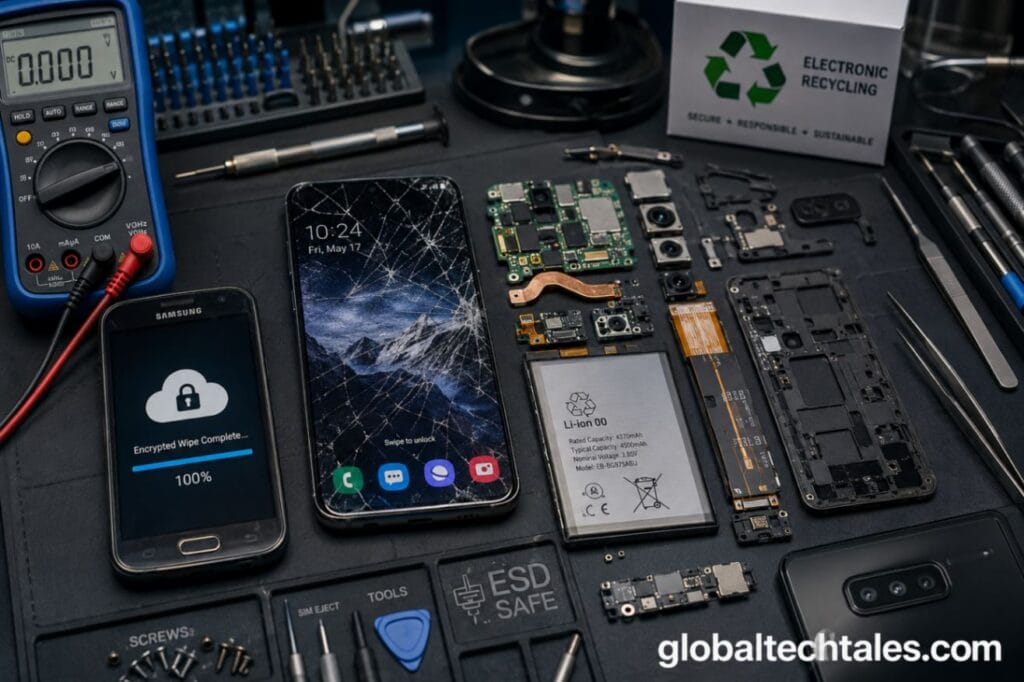
Figure 2: Internal logic layout of degraded smartphone hardware. Even non-booting devices retain recoverable modular assets like camera assemblies, shielding structures, and raw precious metal traces.
Cryptographic Data Sanitization: Protecting Privacy on Broken and Dead Logic Boards
The single most dangerous mistake when offloading old mobile technology is failing to completely erase personal information. Simply assuming a phone is safe because its screen is black or its power button doesn’t respond leaves you completely exposed to data mining. Advanced buyers can easily desolder intact flash storage chips or use custom hardware interfaces to scrape data from your device.
Modern smartphones use file-based encryption by default. This design choice means your data’s safety relies directly on destroying the underlying cryptographic keys stored in the hardware’s secure enclave. When you map out your strategy for how to sell your broken, unusable, obsolete smartphone wisely, you must match your data destruction methods to the specific physical state of the phone’s hardware.
Data Cleansing for Responsive Displays and Functional Software
If your phone retains screen visibility and touch responsiveness, the factory reset process must be handled deliberately to guarantee safety. First, navigate to your account settings and explicitly log out of your Google Account or Apple ID. This step disengages Factory Reset Protection (FRP) and iCloud Activation Locks, which would otherwise render the device completely unsellable to a third party.
Next, run the system’s native factory data reset. This command does not just delete file indexes; it completely flushes the master cryptographic keys from the onboard security chip. For deep technical insight into how mathematical operations secure or obfuscate digital footprints, you can explore our comprehensive breakdown on sliding window cryptographic hashes, which outlines the complex calculation models behind secure system data management.
Blind Reset Protocols for Working Logic Boards with Dead Screens
When a smartphone boots up normally—indicated by vibrations, notification sounds, or charging ledger LED indicators—but features a completely shattered, non-responsive screen, you can execute a blind factory reset using external hardware interfaces.
Connect a compatible USB-C hub to the device’s main port. Plug in a standard computer mouse, keyboard, and an external monitor via HDMI. If the phone supports native display output over its controller line, the lock screen interface will instantly appear on the external monitor, allowing you to open the settings app and run the reset sequence.
For devices that lack display output capabilities, utilize desktop software suites. Connect the device to a computer running official client software like Apple Devices/iTunes or OEM-specific Android desktop managers. By verifying ownership through your cloud account credentials, you can trigger a full firmware wipe directly through the hardwired data pipeline.
Cloud De-Authorization for Bricked or Non-Powering Components
If a device suffers from complete power infrastructure failure and cannot connect to a computer, you must isolate the asset from your digital life using cloud account controls. Log into your Apple iCloud dashboard or Google Device Manager via a separate desktop browser. Locate the broken device in your active hardware asset list and select “Erase Device” or “Remove from Account.”
This action sends a permanent instruction to the cloud authentication servers. The moment a future buyer fixes the power rails or desolders the components to boot the board up, the hardware will immediately run an automated wipe script. This remote control approach mirrors the infrastructure layouts found in distributed systems, which you can study in our guide on stable hardware management ecosystems to see how isolated systems manage data states across remote networks.
| Failure Profile | Highest Value Asset | Target Buyer Audience | Data Risk Level |
|---|---|---|---|
| Broken Display Only | Intact Logic Board & Core APU | Local Refurbishers / Swappa | High (Requires Reset) |
| Water Damaged Board | OLED Matrix & Camera Array | Component Recyclers / eBay Parts | Medium (Requires Cloud Wipe) |
| Obsolete System OS | Perfect Operational Chassis | Hobbyists / Budget Trade-Ins | Low (Standard Wipe) |
Marketplace Optimization: Finding the Perfect Buyers and Avoiding Scams
Once your hardware is correctly categorized and your personal data traces are neutralized, you need to match your hardware asset with the correct purchasing platform. Trying to sell a completely dead phone on a consumer-focused local marketplace usually results in wasted time and low-ball offers. Conversely, sending a lightly damaged premium smartphone straight to a generic e-waste scrap yard throws away significant potential revenue.
Strategic distribution relies on clear, honest presentation. When managing specialized listings, knowing how to sell your broken, unusable, obsolete smartphone wisely means writing transparent technical descriptions that attract professional buyers while insulating you from fraudulent return claims.
Specialized Component Marketplaces (For Broken and Unusable Units)
For devices with shattered screen panels or short-circuited core paths, platforms like eBay (categorized under the “For Parts or Not Working” tier) or specialized buyback programs like ecoATM and Decluttr are highly effective options. Professional salvage teams continuously track these channels to find working components to rebuild customer units.
When building your online listing, explicitly detail the item’s historical context. State exactly what hardware events occurred prior to the device failure, such as a high-velocity drop or liquid contact. Photograph the phone from multiple angles using clear lighting to show every physical imperfection, preventing any structural misunderstandings.
“By explicitly documenting a device’s IMEI number and highlighting every internal defect directly within the listing, sellers create an unalterable paper trail that neutralizes buyer return fraud.” — Basemetal Hardware Liquidation Guidelines
Upcycling Projects and Local Technical Infrastructure (For Obsolete Tech)
If your phone works perfectly but is no longer supported by modern software updates, target developers and tech hobbyists. These legacy silicon systems are frequently repurposed as dedicated hardware controllers, home automation terminals, or network monitoring tools.
An old smartphone can be set up as a low-overhead network status display panel or an IP security camera node. This type of implementation is common for tech enthusiasts who maintain their own local systems. For instance, our deep-dive guide on how to build a home server under $300 shows how older hardware assets can be effectively integrated into a localized network architecture rather than being discarded.
Avoiding Costly Liquidation Blunders: The Rules of Legal and Financial Protection
To successfully complete the sale of your equipment, you must insulate yourself from common transactional disputes and return scams. Professional e-waste buyers operate on tight profit margins and will quickly lower their initial evaluation price if they encounter undocumented issues, such as a locked boot firmware profile or missing minor internal component screws.
Understanding how to sell your broken, unusable, obsolete smartphone wisely involves implementing a rigorous validation process prior to shipping the asset. This approach guarantees that once the asset leaves your workbench, the financial payout remains completely secure.
🛠️ Operational Checklist Before Dispatching Your Hardware
- IMEI Logging: Document and photograph the device’s unique IMEI barcode string to prevent buyers from swapping your functional internal components with a different dead board.
- Carrier Unlock Verification: Contact your cellular network provider to ensure the baseband chip is completely free of financial balances or lease contracts.
- Charge Port Optimization: Clean out any compressed dust or lint from the charging port line using a non-conductive wooden or plastic pick tool.
Maintaining clear power infrastructure integrity is critical when testing your old equipment. If you notice your testing workbench devices are behaving erratically during preparation, review our specialized analysis on why your laptop is charging slowly on USB-C, which explains how voltage drop dynamics and baseline power delivery protocols can impact your diagnostic tools. According to the foundational engineering documentation hosted on the USB Implementers Forum, proper hardware handshakes are required across all charging rails to maintain component safety.
Additionally, the global environmental impact of improper cell phone disposal has led to strict international regulations. As detailed in the comprehensive EPA Electronics Recycling Framework, modern lithium-ion batteries and printed circuit board assemblies contain heavy materials that require certified, clean extraction processes to keep hazardous compounds out of the water table.
Future-Proofing Your Technology Cycle: Turning Hardware Liabilities into Assets
Extracting maximum value from your old electronics is a practical skill that extends well beyond individual device sales. By adopting a methodical approach to evaluating hardware degradation, sanitizing cryptographic data keys, and matching items with the right marketplaces, you protect both your wallet and your digital privacy.
Every broken screen or obsolete operating system represents an opportunity to participate in the circular technology economy. When you learn how to sell your broken, unusable, obsolete smartphone wisely, you prevent valuable raw materials from sitting idle in storage or filling up waste streams, converting depreciated hardware into active capital for your next technology upgrade.